
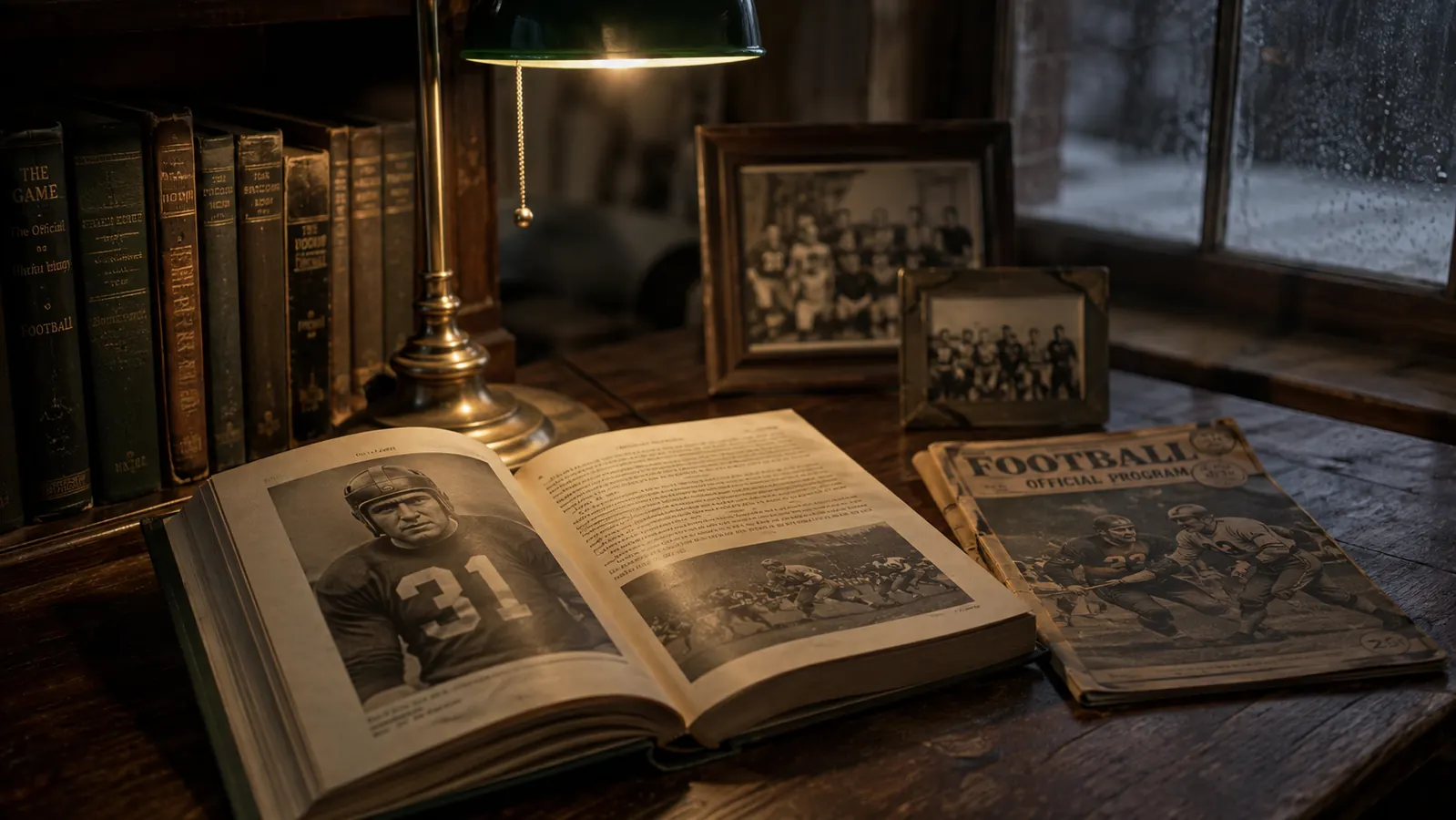
The first football moment that ever stopped me was a photograph, not a play. It was my father's old copy of a Sunday sports section, and there was Vince Lombardi walking off a frozen Lambeau Field with snow on the shoulders of his topcoat, head down, the game already replayed in his head, alone in a way that all great coaches seem to be. I must have been a boy. I pointed and asked who he was, and my dad said the man who taught the whole league how to be a professional. I only understood how much that meant years later, when I finally sat down with David Maraniss's When Pride Still Mattered and let the whole of it wash over me.
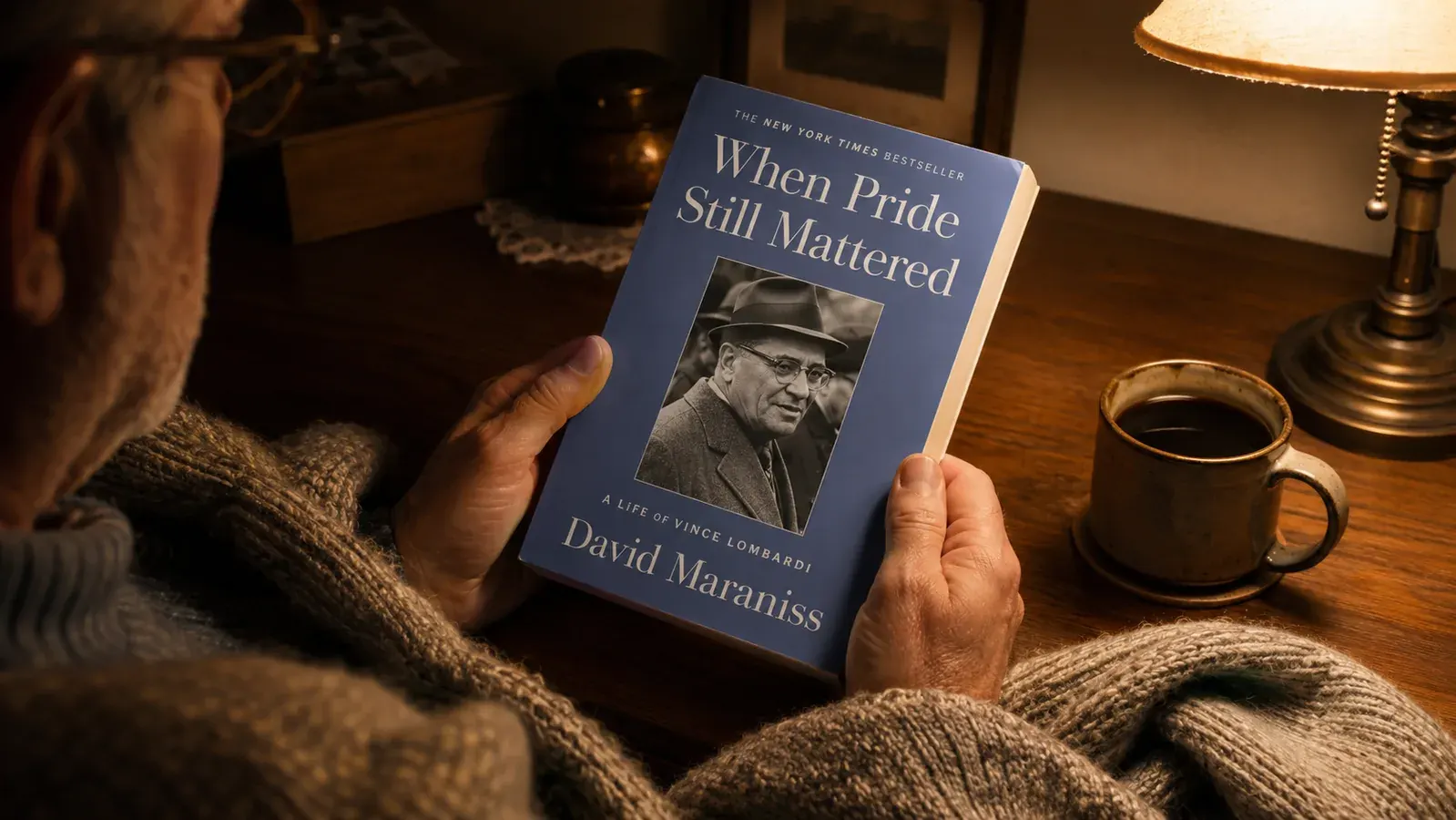
That old photograph stayed with me into my late fifties, so when a friend who used to cover the Packers told me the biography to start with was Maraniss, I shrugged and bought a copy at today's price without much hope. I am a slow reader and a repeat reader. A book has to earn a second pass, and most sports books do not. This one earned it twice, once for the man and once for the league he rebuilt from the frozen ground up. What follows is my honest account of living with it on my desk for a full autumn and winter, not a marketing summary and not a hype job.
The Quick Verdict
Maraniss turns the marble statue of Lombardi back into a real, complicated man, and that honesty is exactly why this remains the one biography of the Packers coach worth owning.
Amazon Check Today's Price →Start with the definitive Lombardi biography
When Pride Still Mattered by David Maraniss reads like a novel built from real documents. If you want the whole arc, from Brooklyn to Fordham to the frozen winters of Green Bay, this is the copy to buy for your own shelf or for the football fan in your family.
Amazon Check Today's Price on Amazon →How I've Used It
I read it the way I read most long history, a few chapters a night at a kitchen table that has a reading lamp and one drawer that never quite closes. It took me about three weeks, and I was not rushing. I did not read it in strict order; I let Maraniss carry me wherever the man's life went, which turned out to be a richer way into it than any clean timeline. What struck me first is how much of the book is not about games at all. It is about a family, a Catholic faith, a ferocious temper, and a set of principles Lombardi carried from his immigrant father Henry in Brooklyn all the way to the sideline in Green Bay.
Because I buy books for other fans in my family, I also tested it as a gift. I gave a copy to a nephew who thinks his whole life in nicknames and scored plays and who would rather watch a replay than read a paragraph. He called me on a Tuesday night to argue about the power sweep, which is not a thing that has ever happened between us before. That alone told me the book reaches a reader who was not alive for any of these seasons, and that is the rarest thing a sports history can do.
I kept a pencil in it, which I almost never do for a book I respect enough to loan out. I marked passages about the 1960 championship, about the ice of the 1961 title game, and about how Lombardi treated a backup like a starter until that man proved otherwise. That last idea I carried straight into how I talk to people at work, and on its own it is worth the whole shelf price. A book that changes how you treat the people around you is doing more than telling you a story.
A Biography, Not a Monument
The reason Maraniss's book holds up after all these years is that he refuses to worship his subject. Lombardi became a statue in American culture before he even died in 1970, and the statue says winning by force of will, grit, and a quote that nobody can agree he ever actually delivered in that form. Maraniss gives you the real man standing behind it. He shows the temper that could reduce a strong lineman to tears and the talking that could fill a whole evening, right alongside the coach who visited sick players in the hospital and did his honest best by the men who bled for him every Saturday afternoon.
That balance is rare in sports biography. Most books about great coaches are either devotionals that never admit a flaw or hit pieces that never admit a strength. Maraniss slips between the two and lands somewhere true. He treats Lombardi's faith as a real and complicated engine, not a punchline. He treats the step up from the Giants as ambition mixed with grievance, not pure football math. The man stays accountable and fascinating at the same time, which is a hard needle to thread across nearly six hundred pages without once losing the reader.
Here is the thing about that honesty: it makes the praise land harder. When Maraniss finally describes the 1961 title game on the frozen ground of Green Bay, or the way Lombardi almost physically willed a team through a bad fourth quarter, you trust it, because he has already shown you the warts. A hagiography cannot give you that. By refusing to turn Lombardi into a saint, Maraniss makes him into someone you actually want to know, and that is the whole game.
Why It Reads Like a Novel
Nobody warned me that it would be this readable. Lombardi-era football books often read like a box score transcribed by a lawyer, dense and dry and determined to file every play in the right drawer. Maraniss is a narrative historian before he is a football writer, and he writes scenes, not summaries. There is an early stretch where he walks you through the ferocity of a Green Bay winter, the kind that keeps a whole town indoors for months, and you feel the cold pressing in while Lombardi paces a dining room that doubles as his office.
He also threads the wider world through the football instead of treating the sport as its own sealed universe. When the civil rights movement forced itself onto rosters and into press boxes, he shows Lombardi navigating it in real time, imperfectly and fitfully, but with more quiet defiance toward segregation than most coaches of his generation could ever have managed. Watching him negotiate the town, the ownership, the players, and a country in upheaval all at once is what lifts the book out of the club biography and into the history section of the shelf where it belongs.
Because the writing is so good, it is the book I now hand to anyone who says they want to understand the NFL but do not know where to begin. You do not need to know a sweep from a screen to follow it. The football is there and it is accurate, but the engine of the story is character, and character is something any reader can recognize. If you love sports history because you love people history, this is exactly the lane you are already walking in.
The Tradeoffs
No book is perfect, and I want to be honest with you rather than sweeten the sale. Maraniss is thorough, and thorough is sometimes slow. Around the middle of the book there are passages about Lombardi's relationship with a specific player or a specific offseason that run a beat or two longer than I needed, especially for a reader who came for the coaching years in Green Bay rather than the earlier Fordham chapter of his life. You will not be bored, but you will sometimes be patient.
There is also the question of era, which is a warning about who should sit down with it more than a flaw in the book itself. Readers under forty did not grow up with Lombardi in the room, so some of the reverence the older generation assumes in passing will read to them as meeting a stranger in a heavy coat. That is not the book's fault. For those readers I would suggest starting with a slimmer, simpler portrait of the man first, then returning to Maraniss for the depth once you have a face on the name.

What Stays With You
Months later, the passages I keep returning to are not the big wins but the small human ones. There is a scene where Lombardi quietly looks after an aging player long past his usefulness, and another where the weight of expectation nearly buckles him and a room full of men sees the cracks. Maraniss gives you the full cost of that kind of excellence, the toll it took on a body and a family and a marriage, and you finish the book with more respect for the price than for the trophy.
I think that is the real achievement of the book, and why I keep recommending it as the best single entry into NFL history for a reader. It is not a celebration and it is not a takedown. It is a life, told the way a life actually goes, with mistakes and contradictions and moments of genuine grace mixed together. By the last page you understand why the trophy carries his name, and you also understand that he was never just the trophy.
The Read for the Rest of the Family
Because I buy these books as gifts, I pay attention to who else in the family can pick one up. My wife, who reads history but has never sat through a full game, read the opening Fordham chapters and stayed for the story of the immigrant family. My brother-in-law, a lifelong Bears fan who would rather lose a toe than cheer for Green Bay, borrowed it anyway and grumbled for two weeks before admitting the man was something. A book that crosses that kind of divide is doing real work, and this one does it because the football is only ever half the point.
That is the highest thing I can say about a sports history. It does not demand that you already care about the sport. It makes you care by the strength of its story. I have handed When Pride Still Mattered to people who have never watched a snap and watched them disappear into it, which is not something I can say for the rest of the football shelf in my house. That reach is the reason it keeps its place on the desk instead of the back of a cabinet.
What I Liked
- Maraniss writes scenes, not summaries, and it reads like a novel
- Restores the real man behind the Lombardi statue without worship
- Wide historical lens joins the football to the civil rights era of America
- Definitive; you will not need a second Lombardi biography
Where It Falls Short
- Serious and unhurried, and the middle sections can feel long
- So much detail asks for patient, willing reading over a few weeks
- Newer fans may want a simpler entry point before tackling its depth
By refusing to worship him, Maraniss gives Lombardi back his humanity, and that is the only version of the man worth living with across nearly six hundred pages.
Who This Is For
This is for the reader who loves the history behind the scoreboard more than the scoreboard itself. If you remember Green Bay winters, if you grew up hearing the name Vince Lombardi and want the man behind it, or if you simply read biographies for character and want the single richest portrait of a coach ever put on paper, this belongs on your shelf. It is also the obvious gift for the Packers fan in any family who already owns every highlight reel and the jersey and the coffee mug.
It rewards the patient reader who can give a book real evenings instead of scraps of time, and it rewards the gift-buyer who wants a book the recipient will actually finish rather than admire. If that is the kind of reader you are, or the kind of reader you are shopping for, you will not regret a single one of the chapter nights you give it.
Who Should Skip It
Skip it for now if what you want is a single Sunday of light reading, or a quick fan primer on how football became what it is. It is a substantial, careful biography, and it asks for weeks, not a commute. If you cannot give a book that kind of patience yet, start smaller and come back. The book is not going anywhere, and it repays you far more on the reading where you arrive ready to sit still and let a life unfold at its own pace.
The one Lombardi biography you will ever need
When Pride Still Mattered by David Maraniss is the definitive life of the Packers coach, told the way history should be told. Grab a copy at today's price, keep it on your shelf, and hand it to the reader who loves the deeper game underneath the scores.
Amazon Check Today's Price on Amazon →