

I keep a shelf of baseball books the way some men keep a shelf of tools they only pull out on weekends. It is not a big collection, maybe twenty volumes, but every one of them has earned its place. And the way most of them earned it is by being a story first and a reference second. That is the whole secret to picking a baseball history book that actually gets read, instead of one that looks good in the catalog and gathers dust after the first chapter.
The trouble is that the word "history" in a book title is a magnet for dry, alphabetical, who-played-where compilations that read like a spreadsheet with a dust jacket. If you have ever bought one of those for a fan you care about, you know the look when they unwrap it: polite thanks, a quick flip through the photos, and then it goes on a shelf and never comes down again. This article is about how to avoid that. I have spent a lot of evenings testing what separates a baseball history book you finish from one you abandon, using The Baseball 100 by Joe Posnanski as the benchmark, because it is the clearest example I know of a book that gets the whole thing right.
The Book I Measure Every Other Baseball History Against
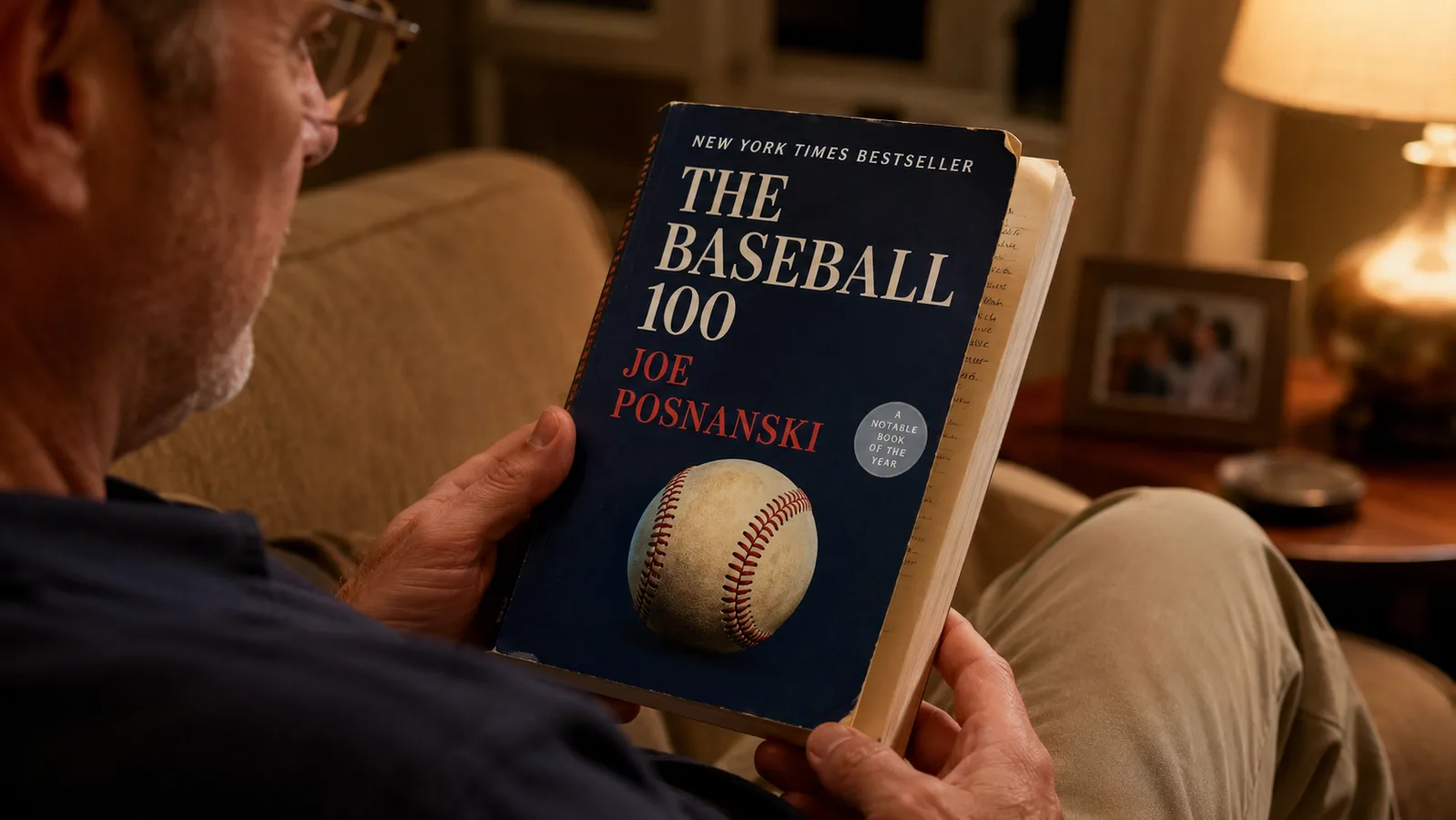
If you want the single best benchmark for what a baseball history book should feel like, start with Joe Posnanski's The Baseball 100, a collection of stories about the 100 greatest players ever, told the way baseball is actually remembered. It is the book I used to build the checklist below.
Amazon Check Today's Price on Amazon →Step 1: Match the Book to the Reader's Era, Not Just Their Favorite Team
Before you buy a baseball history book for anyone, yourself included, think about the decades they actually watched. My own frame runs roughly from the late 1960s through the 1990s, the era I grew up with on the radio and the early cable broadcasts. A book that spends four hundred pages on the dead-ball era of the 1910s is historically important, but it will not hook a man who remembers Willie Stargell and Steve Carlton. The books that stay on my shelf are the ones built around eras I can picture. That is a big part of why The Baseball 100 works so well: it spans the entire game, from the 1880s to the present, so whatever decade a reader grew up with, there is a chapter waiting for it.
The practical test is simple. Read the table of contents and the chapter titles before you commit. If the names are all from one narrow slice of time and none of them ring a bell for the reader you have in mind, keep looking. A good baseball history book is an invitation to the years the reader already loves, with just enough of the before and after to stretch them a little. The Baseball 100 manages this beautifully, because Joe Posnanski orders his chapters not by ranking gimmicks but as a story of how the game changed across the decades.
Step 2: Insist on Narrative, Not Stats
Here is the test that separates a real baseball history book from a reference book: does it tell you how a player felt, or only how many games he won? Statistics give you the outline of a career, but they will never tell you why the whole city of St. Louis stopped what it was doing for an afternoon in August 1968. That texture, the human moment behind the numbers, is what makes a baseball history book worth reading twice. Posnanski is a master of it. In The Baseball 100 he does not recite a batting line and move on. He finds the story inside the stat sheet, the trade that shaped a career, the teammate who changed a swing, the town that decided it loved a player and never explained why.
I will give you one small example of what I mean, because it is the kind of thing that hooks a reader and never lets go. Early in the book, when Posnanski reaches the players who came up before the modern era, he does not treat them as museum pieces. He talks about how the game they played was rougher and stranger, how the rules and the fields were different, how a man could be the biggest star in the country and still look like a working stiff in the team photo. That kind of writing does not just list a career. It drops you into a different America and lets you stand there a minute. That is the difference between a history you read and a history you live in.
When you are weighing a candidate, flip to a chapter about a player you already know something about. Read three pages. If you learn a fact you never knew, and more importantly if you feel the pull to keep going, that is a narrative book. If the same three pages feel like an encyclopedia entry with better grammar, put it back. For readers who prefer story over stats, which is most of us, The Baseball 100 is the clearest example I can hand you of a history that respects the numbers without being ruled by them.
Step 3: Look for an Author Who Did the Research and Can Write
A baseball history book is only as trustworthy as the digging behind it, and only as readable as the writer shaping it. You want an author with real research under them, someone who has talked to the players, read the archives, and gotten things right enough that the fan in the family cannot catch a factual slip on page twelve. But research alone is not enough. There are plenty of scrupulous scholars who cannot write their way out of a box score. The rare author who does both, who is meticulous and still tells a story you disappear into, is worth following across their whole career.
Joe Posnanski is that rare combination, and it is worth saying plainly. Before The Baseball 100 he wrote for Sports Illustrated and had already published well-regarded books on the history of the game. He has spent decades around the sport, interviewing living greats and reading deeply into the past. The result is a book you trust without thinking about trusting it. For a beginner in this corner of the library, checking an author's track record is one of the fastest shortcuts you can take, and Posnanski's name on the spine is about as safe a bet as the genre offers.

Step 4: Decide Between a Single Life and the Whole Span
There are really two kinds of baseball history books, and knowing which one the reader wants saves a lot of guessing. The first is the deep biography, a whole volume devoted to one figure, like the great studies of Jackie Robinson or Babe Ruth. These reward a reader who is already fascinated by that particular man. The second is the wide history, which tries to tell the story of the whole game, or a whole era, across many lives. The Baseball 100 sits firmly in the second camp. It uses a hundred individual stories to build one long, connected history of baseball in America, from the earliest generations through the modern game.
Neither kind is better, but they serve different readers. A wide history like The Baseball 100 is the better gift for a general fan, because it does not assume they already care about one specific player. It meets them where they are and lets the stories do the persuading. If the person on your shopping list is already obsessed with, say, Ted Williams specifically, then a deep biography of Williams is the sharper choice. Match the shape of the book to the shape of the reader's interest, and you will rarely go wrong.
Step 5: Check That It Lends Itself to Dipping Back In
This is the test that nobody talks about, and it matters more than the others. A great baseball history book is not read once and shelved. It is the kind of book you set down on the arm of the chair and pick back up between innings for months, the kind you open to a random chapter on a quiet Sunday afternoon when there is no game on. That re-readability is hard to design, but you can spot it. Ask whether the book is built in chapters that stand on their own, each one a complete little story you can enter without remembering where you left off.
There is one more practical thing to look for, and it is the one gift-buyers overlook most. A baseball history book for a fan in the family is often bought to spark conversation, a way to get the older generation talking about the players they loved and the afternoons they remember. A book that reads like a roster never does that. A book that reads like stories does. Buy the one that your father-in-law or your uncle will want to quote back to you at the dinner table, and you have not just given a book, you have given a reason to sit down together. I have made that mistake and learned from it, and it is the single best reason to put narrative first.
The Baseball 100 is deliberately built for dipping into, one player per chapter, each chapter a self-contained portrait you can read in a sitting or stretch across a season. I have come back to it a dozen times and always land somewhere new. For a reader in his late fifties who reads in the evenings, which is me, that is not a small thing. It means the book never demands a run-up, and it never punishes you for reading in twenty-minute stretches before the lamp gets turned off. That is the quiet quality that turns a good history book into a permanent resident of the shelf.
What Else Helps
A couple of habits make a baseball history book go further. If you are buying for someone older, look for an edition with decent print size, because fine print and hours of evening reading are not friends. Paperbacks are lighter and easier to hold in a chair, while a hardcover sits better on the shelf as a gift. Whichever you choose, wrap it with something small: a scorebook, a pack of the reader's favorite peanuts, an old ball. The gift is the book, but the ritual around it is what makes it memorable.
One more honest note. No single book covers every era equally, and The Baseball 100 is no exception. Its job is breadth across the whole game, so a reader who wants one specific season or one specific franchise covered in depth will want a second, narrower book alongside it. Think of The Baseball 100 as the foundation of a shelf, not the entire wall. It is the book you build around, and five years later it is still the one you reach for first.
I have come back to The Baseball 100 a dozen times and always land somewhere new, which is the quiet quality that turns a good history book into a permanent resident of the shelf.
Start With a Book Built for the Long Shelf
If you want a baseball history book that reads like stories instead of stats and stays on your shelf for years, The Baseball 100 by Joe Posnanski is the benchmark I would buy first. Check today's price before you order.
Amazon Check Today's Price on Amazon →