

I read sports history the way some men watch it, a few chapters most evenings in the chair by the window, and for a long time I bounced off football history completely. The books were full of rosters and box scores, who gained how many yards against whom in 1962, and it read like a ledger instead of a story. I wanted the drama I remembered from old footage, the frozen breath on the sidelines, the men who built the game. What I kept finding was a stat sheet with a hardcover on it.
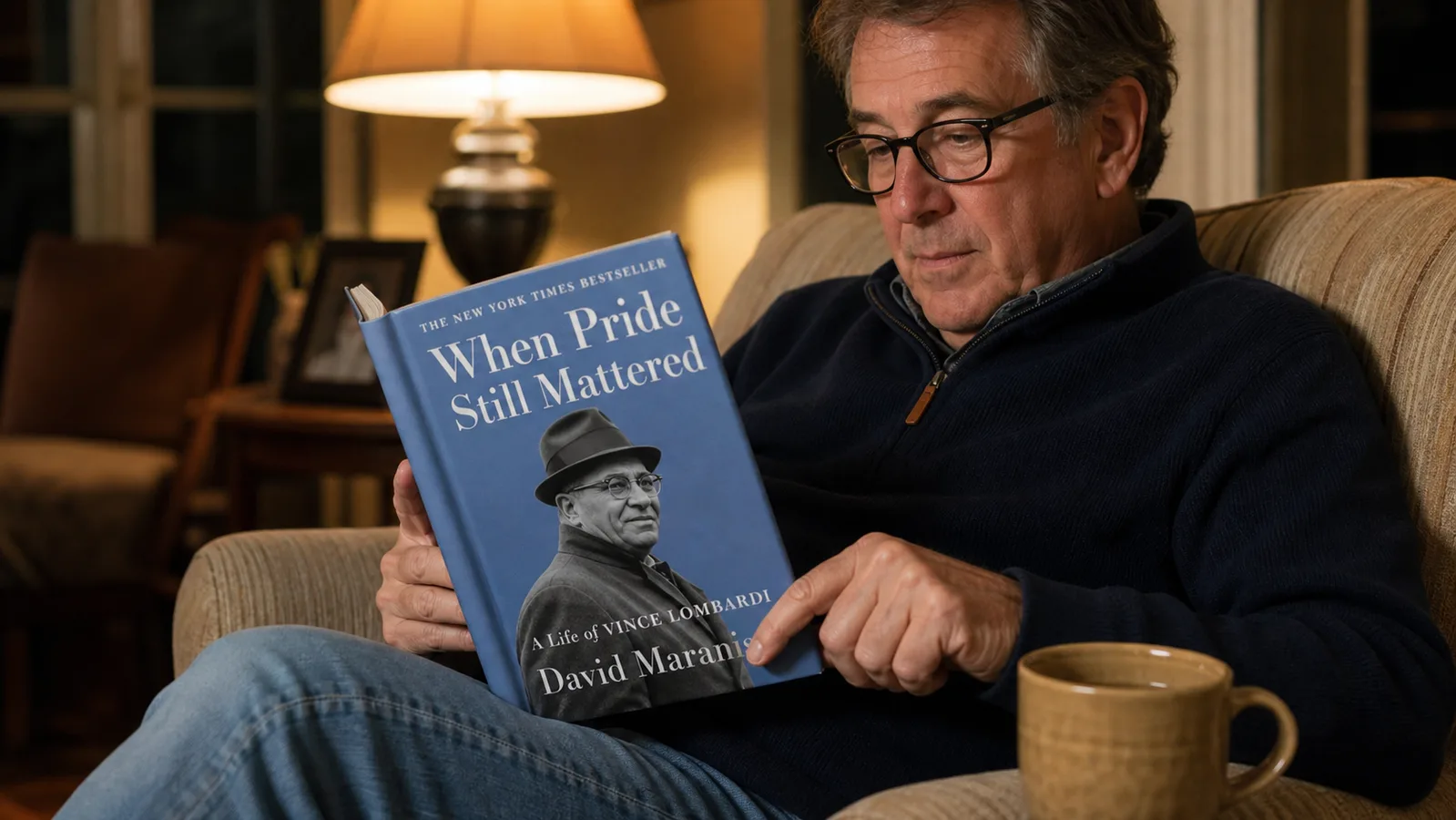
The book that fixed it for me was David Maraniss's When Pride Still Mattered: A Life of Vince Lombardi, and it fixed it by doing something I did not expect. It is a biography of one coach, yet it explains the entire modern game, because Lombardi stands where he stands in the lineage. Once I saw how Maraniss built it, I could read almost any football history with enjoyment, because I finally knew what to look for. This guide is the five steps I now use every time I pick up a book about the sport, whether it is about Lombardi, the Packers, or a season I was not alive to see.
The biography that taught me how to read football history
David Maraniss's When Pride Still Mattered is the football history book I measure every other one against. It reads like a story and explains the modern game, and it is the model for everything in this guide.
Amazon Check Today's Price on Amazon →Step 1: Start With One Man, Not One Decade
Football history is a hundred years of franchises and championships, and trying to take it all in at once is how you end up with that ledger feeling. The cure is to walk in through a single door. Pick one person, not an era and not a league, and read about that man until you care what happens to him. Lombardi is the obvious door for most readers, because his name is on the Super Bowl trophy and because his story touches everything that made the modern game. But the rule works with anyone. George Halas in the early years, Tom Landry building the Dallas system, a coach from your own hometown who started something.
Once you care about the person, the games stop being statistics and start being chapters. You want to know whether this son of a Brooklyn butcher can turn around a franchise that has not had a winning season in a decade, and that is the entire engine of narrative. Maraniss understood this completely. He spends pages on Lombardi's childhood in an Italian immigrant neighborhood, the years teaching high school, the assistantships at West Point and with the New York Giants, before the Packers ever hire him. By the time he walks into Lambeau Field in 1959, you are a few chapters deep in a life you have invested in.
The practical version of this step is simple. If a football history book opens with a list of champions and their won-loss records, stop and find the one that opens with a character. A great football history introduces the man as a person before it introduces him as a coach. Start there, and the history follows almost without effort.
Step 2: Learn the Signature Play Before the Plays
Every coach has a play that carries his fingerprint, and Lombardi's was the Green Bay Sweep. Maraniss breaks it down in enough detail that you could almost draw it from memory: the two guards pulling out of the line, the convoy of blockers forming around the corner, the halfback choosing the seam at full speed. Understand that one play and you understand how Lombardi thought, which is that execution and repetition beat surprise every time. The sweep is not trivia. It is the clearest window into a whole coaching philosophy.
This is where reading for insight rather than trivia pays off. The sweep itself has been out of style for decades, but the lesson has not. When you watch a modern offensive line zone-block a stretch run on a Sunday, you are watching a direct descendant of what Lombardi drilled every August in Green Bay. Maraniss never has to spell the connection out for you, because it makes itself, and suddenly the modern game has a family tree you can trace.
The detail matters more than the diagram. Maraniss explains why Lombardi's linemen pulled the way they did, how the timing between blocker and runner had to be perfect, and what it cost the team when it was not. That kind of grounding turns a highlight into a craft. It is the difference between watching football and actually reading it, and it is the reason this book works as a history of the sport and not just a biography of one man.
Step 3: Put One Game Back in Its Year
The Ice Bowl is the game every football history book eventually has to describe, and Maraniss's account is the best I have read. New Year's Eve, 1967, Lambeau Field, thirteen degrees below zero with the wind chill far past that. The Dallas Cowboys against Lombardi's Packers for the NFL championship. Players said afterward that the ball felt like a rock, that hands froze to the helmet straps, and that the frost came off the bench in sheets. If you only know the game as a famous title, this is the chapter that will show you why it earned the name.
Maraniss builds the scene the way a novelist would. The frozen turf was so hard the officials could not drive their studs into it, so the Packers brought out a heater and melted part of the field before kickoff. Dallas took the lead on a Dan Reeves halfback pass in the fourth quarter, and then Bart Starr drove the Packers down the field with no timeouts left, finishing with a bare-handed quarterback sneak on third and goal with sixteen seconds on the clock. The cold, the clock, the stakes, it all lands at once.
One game, one frozen afternoon, gives you the stakes of the entire era better than any overview could. That is why I tell people to read this section twice. It is the chapter where Lombardi's discipline, the roster's talent, and the brutal conditions all come together, and it is the proof that a single well-chosen game can anchor a whole decade of history in your memory.
Lombardi coached the Packers for nine seasons and won five championships, and Maraniss makes you feel each one as a struggle, not a coronation.

Step 4: Read the Man Against His Times
The mistake a casual reader makes is treating a football history book as pure sports. Lombardi built his greatest teams during the most turbulent years of modern America, and Maraniss never lets you forget it. He sets the Packers' championship run against the civil rights movement, the assassinations, the war overseas, and the players who pushed back on Lombardi's iron rule. The football stops being a ball and becomes a lens on the whole country. That is the deep pleasure the genre offers: football history is American history with a scoreboard.
You see Lombardi's complicated side as well. He drove men to the edge of what their bodies could take, and some of them resented him for decades afterward. Maraniss lets those players speak at length rather than settling for the legend, and that honesty is what makes the book trustworthy. A hagiography would have handed you a trophy. This history gives you the whole man, the fear and the love in the same chest, which is rarer and more valuable.
One detail has stayed with me for years. Maraniss describes how Lombardi's own players, the men who feared him most, turned out in the hundreds for his funeral in 1970, because underneath the fear was something they could not name at the time. That tension is the real subject of the book, and it is what lifts it above the ordinary run of sports writing. When you read the man against his times, the coach becomes a character, and the history becomes a story.
Step 5: Follow One Thread Forward to Today
The final move is the most satisfying. Once you have the man and his era, chase a single thread forward to the present, and Lombardi's runs through everything. The Super Bowl trophy carries his name. The Packers have never stopped being his team. And the assistants and players who learned under him carried his methods into coaching trees that reach the men pacing the sideline on your screen every Sunday. Follow the thread, and the decades stop being separate boxes.
That is the trick of reading history well. You stop treating each era as a closed chapter and start seeing one continuous game. When a modern coach talks about fundamentals, about the power run, about doing your job, you will hear the echo. Maraniss gives you the vocabulary to notice it, and that is the whole payoff of reading football history for insight rather than trivia. The book hands you the next book, too, because by the last chapter you have heard enough about the merger, about the coaches who followed, about the players who carried the lessons forward, to know exactly what you want to read next.
This is how a casual interest becomes a shelf. You do not read a syllabus. You read one book, it points you at another, and suddenly you have a working picture of the whole sport built out of stories you actually remember. The Lombardi biography is a strong start because it connects to almost everything, the rise of the league, the culture of the sixties, the coaching lineage of the modern game. Read it, and you will never be short of a next book.
What Else Helps
A couple of habits stretch a football history book further. Watch the game footage after you read about it, not before. If you know the outcome already, the reading loses its tension, but if you read the build-up first and then see the old films, both feel richer. Put a note in the inside cover with the key names and the year, the way you would park a story you want to remember. And for readers in the family who grew up with the Packers or the Cowboys, a football history book is the rare gift that starts a conversation, so buy one you can talk about over the table rather than a dry reference they will shelve politely.
For the shelf around this book, add Michael MacCambridge's America's Game for the broad sweep of pro football's rise, and David Halberstam's The Education of a Coach for how Lombardi's lineage reaches Bill Belichick and the modern New England era. Read the Maraniss biography first and let the others build out from it. That order is the difference between a working knowledge of football history and a random pile of facts that never connect.
Start with the biography that explains the whole sport
If you want to feel football history as a story instead of a stat sheet, David Maraniss's When Pride Still Mattered is the book I would put in your hands first. Check today's price before you order.
Amazon Check Today's Price on Amazon →