

If you grew up seeing Muhammad Ali the way I did, the man on the highlight reel comes first. The rope-a-dope in Zaire, the right hand that seemed to arrive before it launched against Sonny Liston, the torch raised with trembling hands at the Atlanta Games in 1996. At some point it hits you that the clips only cover the ninety seconds he was fighting, and that this man performed in public for fifty years. The man who shows up in the ring between those moments, the one who stood over Liston and shouted, is a different person every decade, and no two-minute clip can hold him. Most Ali books hand the whole story to a single writer's opinion. Thomas Hauser went a different way. He spent years with Ali in the late nineteen-eighties, then went out and interviewed the people who raised him, fought him, cornered him, jailed him, and loved him. Then he got out of the way and let them talk.
This is a long-term review of Muhammad Ali: His Life and Times, the biography Hauser built from hundreds of those interviews. I read it slowly across two winters, a few chapters a night, and I have gone back into it since, hunting for a single voice or one night's fight. I want to tell you what the book actually is, why it reads the way it does, and the honest places where it tired me out, because a book this long owes you a straight answer, not applause.
The Quick Verdict
Hauser gets out of the way and lets Ali and the people who knew him tell the story, which is why this is the Ali book every other one gets measured against.
Amazon Check Today's Price →Start with the book most Ali biographies measure themselves against
Muhammad Ali: His Life and Times gathers voices from every corner of Ali's life into one chronological story, from the Louisville boyhood to the torch in Atlanta. If you buy one Ali book this year, this is the one.
Amazon Check Today's Price on Amazon →How I've Used It
I read it the way you read a very long witness transcript, which is more or less what it is. The opening chapters trace Clay's Louisville childhood through the gold medal in Rome in 1960, and the voices stack up quickly, a schoolteacher, the police officers who ran with him as a boy, the trainer who saw what nobody else saw yet. Around the Liston fights the rhythm settles into something close to hypnotic, and men who were only names on the back of a record card start finishing each other's sentences.
The second winter I read it differently. I would open to a chapter on a fight I cared about, the two wars with Joe Frazier or the night with George Foreman in Zaire, and read only those voices. The book works that way too, which surprised me. You can read it cover to cover, or you can treat it as a reference you happen to enjoy reading, and both approaches hold up.
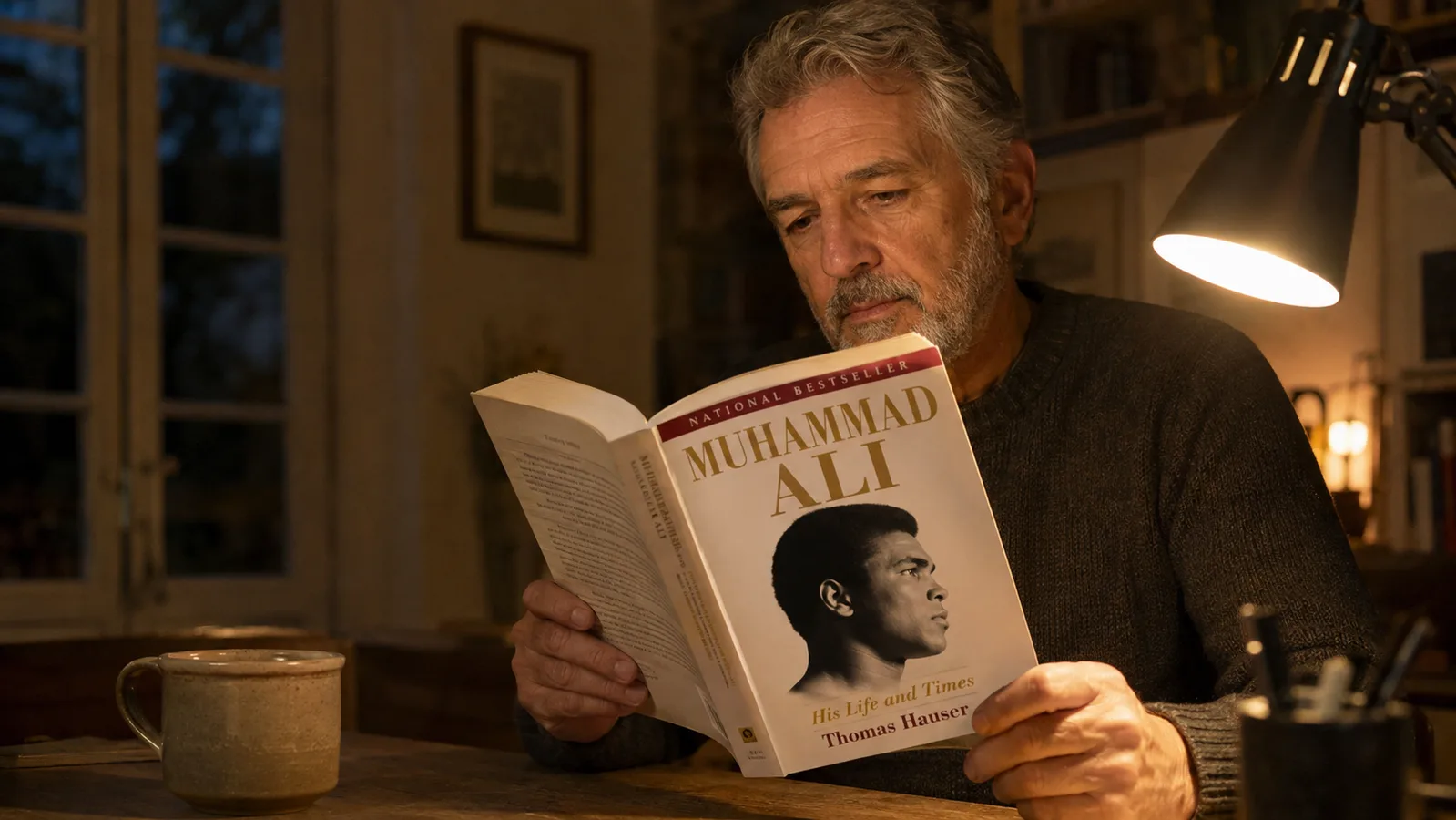
It runs past five hundred pages and it is not a quick book. I kept a paper slip in it for two winters and still found myself rereading passages before turning the page. That is the honest experience of it. It asks for evenings, and it rewards exactly what it asks for.
The copy on my shelf has been loaned out twice, which is my real test for a history book. My brother-in-law, who watched the second Frazier fight on a closed-circuit screen in nineteen seventy-four, borrowed it at Thanksgiving and did not hand it back until March. When he did, he said it read like a whole era giving testimony. I have thought about that sentence a lot since, because it is exactly right.
Why Hauser Built It This Way
The decision that defines the book is the structure. Hauser interviewed hundreds of people and arranged their words chronologically, so the story comes at you the way testimony comes at a jury, from many mouths at once. Ali himself gave Hauser extraordinary time and access in the years after his fighting career ended, and Ali's voice runs through the whole book, strong and unmistakable. But he is never the only voice. When Ali remembers a thing one way, the man across the ring remembers it another, and you sit with both versions.
That choice costs the book a single author's verdict. Hauser, who practiced securities law before he became one of boxing's most careful writers, rarely steps in to tell you who is right. For a reader who wants to be told what to think about Ali, that is a genuine frustration. For a reader who wants to understand how one city, one sport, and one country could disagree about a single man for fifty years, it is the entire point of the exercise.
More than three decades on, the book's reputation has only grown. Look at any list of the best sports books ever published and this one sits near the top. Trainers, journalists, and even later biographies quote it back at you, which is how you recognize a book that became the source every other writer drew from. I did not grow up in Louisville and I never watched any of these fights live, and even so I have reread the Liston chapters more than once.
It also keeps the telling alive in a way a museum biography never is. The fight doctors, the Miami rabbis, the FBI agents who watched the Nation of Islam, the corner men in Manila who watched Joe Frazier beg for one more round. Every one of them keeps a slightly different memory of the same man, and the memories never fully reconcile. That is the most truthful portrait of Ali I have met in forty years of reading this sport's history. If you like your history told by the people who were in the room rather than by a narrator hovering above it, this is the book you have been looking for.
I found myself reading whole chapters aloud to my wife in the evenings, which is not a habit I have. The voice of the old corner man describing the weight of Ali's hands, the trainer who could not watch the third Frazier fight, the reporter who stopped covering him after the draft stand, they all sound so much like speech that you want to hear them spoken aloud. That is a strange and welcome thing to be able to say about a sports book five hundred pages long, and it is the single best reason to trust the recording Hauser made of the era.
The Man, Not Just the Fights
The stretches that changed how I see him are not the famous ones. The refusal to be drafted, the stripped title, the three and a half years in the dark between nineteen sixty-seven and nineteen seventy, those land harder here than any single fight. The lawyers, the draft board, the fighters who crossed the picket lines to keep feeding their families, they all show a price I never once saw in the highlights. And the book does not flatter its subject. He can be cruel, and the pages on Joe Frazier are hard to sit through, because they should be.
The Frazier chapters are the heart of the book. The first fight in March nineteen seventy-one, fifteen rounds with Ali on his back for three seconds in the final round, remains the loudest night in boxing history. The third, the Thrilla in Manila in October of nineteen seventy-five, comes across in the testimony as something that should never have happened, and the account of it is exhausting to read, because it is exhausting to bear witness to.
Over all those voices a man accumulates who changed in public, in front of nearly every audience he ever had. The needling Cassius Clay, the silenced and defiant champion, the older Ali lighting the torch in Atlanta while his hands shook. Hauser never forces that arc on you. It simply builds, voice by voice, until the last pages close on a figure who was never one thing for very long.
There is life after the ring in here too, the humanitarian trips, the hospital visits, the slow arrival of Parkinson's, and Hauser does not flinch at any of it. I finished the book on a cold evening in early March and sat with it closed in my lap for a while. That is the kind of book it is. Not one you finish and shelve. One you finish and sit with, then go looking for one more voice.
Where It Drags
The cost of all those voices is momentum. The middle sections, especially the exhibition years and the slow climb down in the late nineteen-seventies, have stretches where one interview after another says roughly the same thing, and the book starts to feel like its own archive. I flagged three or four passages where I genuinely considered skipping ahead, and skipping is not something I normally do.
The other limit is quieter. Even inside five hundred voices, the man's inner life stays partly behind a curtain, because he kept it there and the book respects the guard. You come away knowing what happened and still sensing that something in Ali never went on the record. That is honesty on Hauser's part, but it is also an absence you can feel in the final hundred pages.
Read with a modern eye, the book gives Ali's treatment of the women around him less weight than it deserves. His wives appear, and his mother appears, but the telling largely belongs to the men in the gym and the men in the street. I felt that absence, and the reader today is liable to feel it more sharply than I did.
It is also a demanding gift. When you press a book into someone's hands you are asking for their evenings, and this one asks for a great many of them. Give it to a reader who will actually sit down with it, and not to the fan who wants a highlight all over again.
What I Liked
- Real oral history built from hundreds of voices, not one writer's opinion
- Ali himself cooperated, and his voice carries the whole book
- The draft, the exile, and the Nation of Islam years are handled with real restraint and care
- Works as a deep reference as well as a narrative, so it rewards a second visit
- Does not flatter Ali, which is exactly why the portrait can be trusted
- The Frazier and Foreman chapters are as good as sports writing gets
Where It Falls Short
- More than five hundred pages and genuinely demanding, not a weekend read
- The middle stretches repeat themselves and can drag
- No single author's verdict, which frustrates readers who want one
- The man's inner life stays partly hidden even at this length
It does not flatter Ali. The pages on Joe Frazier are hard to sit through, because they should be.

Who This Is For
This is the Ali book for the reader who already knows the fights and wants the whole public life behind them, the boy from Louisville, the exile, the convert, the comeback, the decline, told by the people who were there. If you read sports history for the people rather than the box scores, this is your book. It is also the book to give the older fan in your family, the one who watched Ali fight live and wants to hand his memories to someone with the context to hold them. That man is exactly who I picture when I recommend it.
And there is a second reader I keep in mind, the one who barely cares about boxing at all but cares deeply about the nineteen-sixties. The book is a full account of that decade as much as it is a sports book. Conscience, draft resistance, faith, celebrity, the whole argument America had with itself, and it all happens to be standing in one pair of boxing gloves.
Who Should Skip It
If you want one crisp author's argument about who Ali was, this is not the book, and you will tire of five hundred voices telling you slightly different things. There is nothing wrong with wanting that. If you are new to boxing and do not yet carry the fights in your memory, some of the testimony will fly past you, because the book assumes you already know Frazier and Foreman and Liston by sight. Start with a shorter account if that is you, then come back. This book rewards the return.
Alternatives I Considered
The obvious alternative is Ali's own memoir, The Greatest, and I have written a full comparison of the two. The memoir gives you Ali's version in his own hand, and it is essential reading, but it is one voice, and a voice with reasons to be gentle with itself. Hauser's oral history is the other half of that pairing. Read both and you have the whole argument.
The modern rival worth naming is Jonathan Eig's Ali: A Life, a conventional narrative biography by a fine writer that moves faster than Hauser does. Eig tells you what he thinks of Ali. Hauser hands you the record and steps back. I keep both on my shelf. Between the two, on a cold night, this is the one I open first.
The Ali book that asks for your winter evenings
Muhammad Ali: His Life and Times is the biography most other Ali books measure themselves against. Check today's price before you settle on any other Ali book.
Amazon Check Today's Price on Amazon →