

You have room on your shelf for exactly one Muhammad Ali book, and you keep going back and forth between the two that everyone names. I did the same thing, and in the end I bought both, which is the coward's way out but also, it turned out, the only honest way to answer the question. Muhammad Ali: His Life and Times by Thomas Hauser is the big one, the oral biography built from more than a hundred interviews. The Greatest: My Own Story is Ali's own memoir, written with Richard Durham and published in 1975 at the very top of his fame. They are not two versions of the same story. They are two different men standing in the same room.
If you want one book that holds the whole life, buy Hauser's. If you want Ali himself, warm and funny and unmediated, buy The Greatest. And if you can manage it, buy both, read the memoir first on a long weekend, then settle into the biography for two unhurried weeks. That is the order I finally landed on, and I have not found a better one. Below I lay out exactly what each book gives you, where each one honestly beats the other, and who each one is for, so you can decide without buying two copies the way I did.
Two Windows on the Same Man
Hauser's book came out in 1991, published by Simon & Schuster, and it won the William Hill Sports Book of the Year award, which is a good signal for a book that is half history and half sports writing. It runs past 500 pages and covers everything: the boy in Louisville, the Olympic gold medal in Rome in 1960, the two Liston fights, the name change, the draft refusal in 1967 and the three and a half years of exile that cost him his finest fighting years. You follow him through the Frazier wars, the Rumble in the Jungle, Manila, and on into the long public life that followed his boxing career.
Ali's own memoir, The Greatest, stops in 1974 with the Foreman fight in Kinshasa, which means it never reaches the hardest parts of his life. It was published in 1975, the year after the Rumble in the Jungle, and the man writing it is on top of the world, world champion again. That timing is the whole character of the book. Richard Durham, a serious writer and radio dramatist, shaped it so that it reads exactly the way Ali talked: rhyming, teasing, skipping forward, never bored. You can hear him in every sentence, which is the one thing a biography can never give you.
| Muhammad Ali: His Life and Times | Greatest: My Own Story | |
|---|---|---|
| Perspective | A mosaic of more than a hundred voices, the people who knew him, weighed against one another | One voice only, Ali himself, telling his own life |
| Voice | Ali assembled from outside by a journalist who studied him for years | Ali unplugged, funny and magnetic, in a cadence nobody else could reproduce |
| Time span covered | From the Louisville boy to the man who carried the torch in Atlanta in 1996 | Ends in 1974 with the Foreman fight in Kinshasa |
| Factual reliability | Every memory cross-checked against the written record | A star's memory of his own life, warm but selective |
| Length and pace | Over 500 pages, best read in sittings across a week or two | A brisk first-person read you can finish in a weekend |
| Best for | The reader who wants the whole man and the whole era | The reader who wants Ali's voice first and the archive later |
Where Hauser's Biography Wins
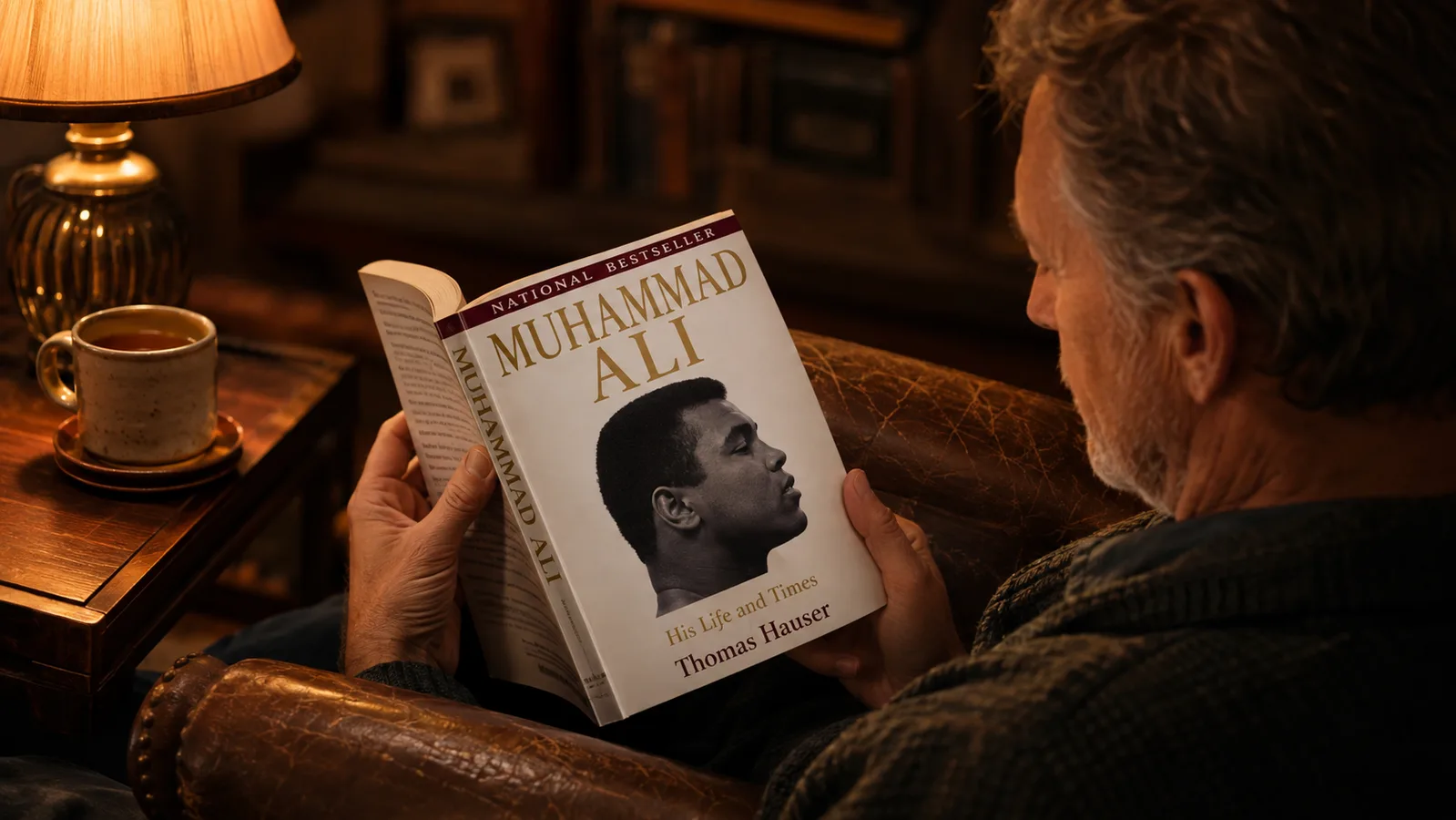
The single fact that decides this category is that Ali himself would not sit for an interview with Hauser. He simply declined, and Hauser pressed on anyway, talking to more than a hundred people who knew him. That refusal is why the book has its unusual shape, and also why it is fair where a memoir cannot be. Angelo Dundee, his trainer, is here, and Bundini Brown, who gave him the float-like-a-butterfly line. Howard Bingham, his photographer and closest friend, is here, and so are Don King, the judges, the doctors who treated him in his later years, and the reporters who covered every fight.
The result is an account that has been cross-checked. When two people remember the same night differently, you get both versions, and you get Hauser quietly weighing them. That matters with a life as public and as contested as Ali's. The exile years, 1967 to 1970, when the boxing commissions took his license and the government took his passport, are told from the inside by the people who stood with him, and you understand the cost in a way that highlights and highlight reels never manage. For a reader who wants the whole man and the whole era, the politics and the religion and the money, this is the book, and it is the one historians reach for.
It is also honest about the limits of the form, which I respect. Because most of the voices in the book are people who loved Ali, the harshest assessments can arrive at a distance, and the book is gentler with him than some of the reporting of his era was. Hauser does not hide this. He lets the reader see who is speaking and what they had to gain. That transparency is exactly why I trust this biography, and it is the reason a copy is staying on my shelf after the memoir has been read once and passed along.
Ali himself would not sit for an interview with Hauser, so the man you get in the biography is the man everyone around him saw, trainers, friends, judges, doctors and rivals.
Where The Greatest Wins
No journalist, however patient, can reproduce the way Ali actually talked, and that is the whole argument for The Greatest. Read the passage about the night he beat Sonny Liston in Miami Beach in 1964 and you are sitting in the dressing room with a twenty-two-year-old who knows exactly what he has done and cannot stop laughing. The poems are here too, the pre-fight rhymes he made for his opponents and the boasts that sounded like jokes until they came true. Durham was smart enough to write it down in Ali's cadence rather than polish it into ordinary prose, and the book reads faster than anything else in the Ali library.
It also ends at the top. The Greatest closes with the Foreman fight, the rope-a-dope, the knockout, the man at the summit of his life, and there is something valuable in leaving him there. You do not have to watch him lose to Holmes in 1980 or confront the illness that shadowed his last decades, because Ali chose to stop telling the story before those years came. For a gift to a young reader, or for anyone who is not sure they want a 500-page biography yet, that is not a flaw. It is exactly the right length, a book you can finish in a long weekend and still feel you have spent real time with him.
I will be honest about the trade that comes with that voice. Ali was telling his own story, and he told it the way he wanted it remembered. Some facts sit differently in his telling than they do in the record, some rivals come out better or worse than history has judged them, and none of it is checked. If you read only The Greatest you will be charmed, but you will also be reading one man's curated version of his own life. You will not know what you are missing until you read the biography.
Start With the Book That Holds the Whole Life
I have read both and I keep reaching back for Hauser's. More than a hundred voices, cross-checked and weighed, covering every year of a life that started in Louisville and ended under the world's spotlight. It holds the middle of a reader's shelf for good reason. Check today's price and see why the biography is the one historians cite.
Amazon Check Today's Price on Amazon →
Who Should Buy Which
Buy Muhammad Ali: His Life and Times if you want the complete man: the politics, the religion, the five years in exile, the Frazier rivalry, the doctors of his later years, all of it weighed and cross-checked. You need to be willing to sit with a long book, because this one rewards unhurried reading the way a great biography should. If you have already read a shorter Ali book or a fine long article and you are ready to go deep, this is the purchase. It is also the right choice when the gift matters, because a substantial biography on a shelf says something that a slim memoir cannot. I gave a copy to my older brother, who watched Ali on closed circuit in 1974, and the book has been through his hands twice since. That tells me more than any review ever has.
Buy The Greatest if you want Ali unplugged, fast, on a weekend, without committing to six hundred pages. It is a better first book for a reader who is new to boxing history, for a teenager, or for someone who swears they do not read nonfiction. It is also the right gift for a person who remembers the 1970s and wants the voice back, not the archive. And if you read this owning one of the two already, buy the other. They are not competing editions of the same story. They are two halves of one life, and together they are the closest you can get to the whole man.
Two Books, One Life, One Easy Decision
If you are still weighing it, my vote is Hauser's biography first, and the memoir as the perfect second book. The biography is the one you will keep returning to for years, and both sit at a modest today's price. See what it sells for at the moment and decide with the whole picture in front of you.
Amazon Check Today's Price on Amazon →How I'd Read Them in Order
The order I settled on, after buying both like a man who could not choose, was the memoir first and then the biography. The Greatest runs hot and fast and gives you Ali's voice, his jokes, his reading of his own life, the high note of Kinshasa. It takes a weekend. Then the biography layers in everything the memoir could not say, the voices of the people around him, the exile years, the doctors, the record and the weighing of it. Read that way the memoir is the appetizer and the biography is the meal, and the second book makes the first one make sense in ways you did not expect.
On the gift question, since I am usually buying these for someone else as much as for myself, my honest advice is to let the reader's habits decide. The person who tears through a book in a weekend and quotes it back at dinner will do better with The Greatest, because they will actually finish it. The person who keeps a history on the bedside table for a month and marks the margins is a Hauser reader waiting to happen. I have given both away in the last year, and neither has come back with the pages unread, which is the highest praise I know for a work of nonfiction.
Whichever you buy first, do not read them in the same week. Let the voice of one settle before you pick up the other, because the two disagree with each other in instructive ways and you want to notice the disagreement. Ali's memory of a night in Manila will not always match the memory of the corner man who worked his gloves, and that clash, not either book alone, is where the real history lives. That lesson is why my usual habit, reading just one title about a man and moving on, failed me completely here. These two books need each other, and the reader who buys both gets more than twice as much as the reader who buys one.