

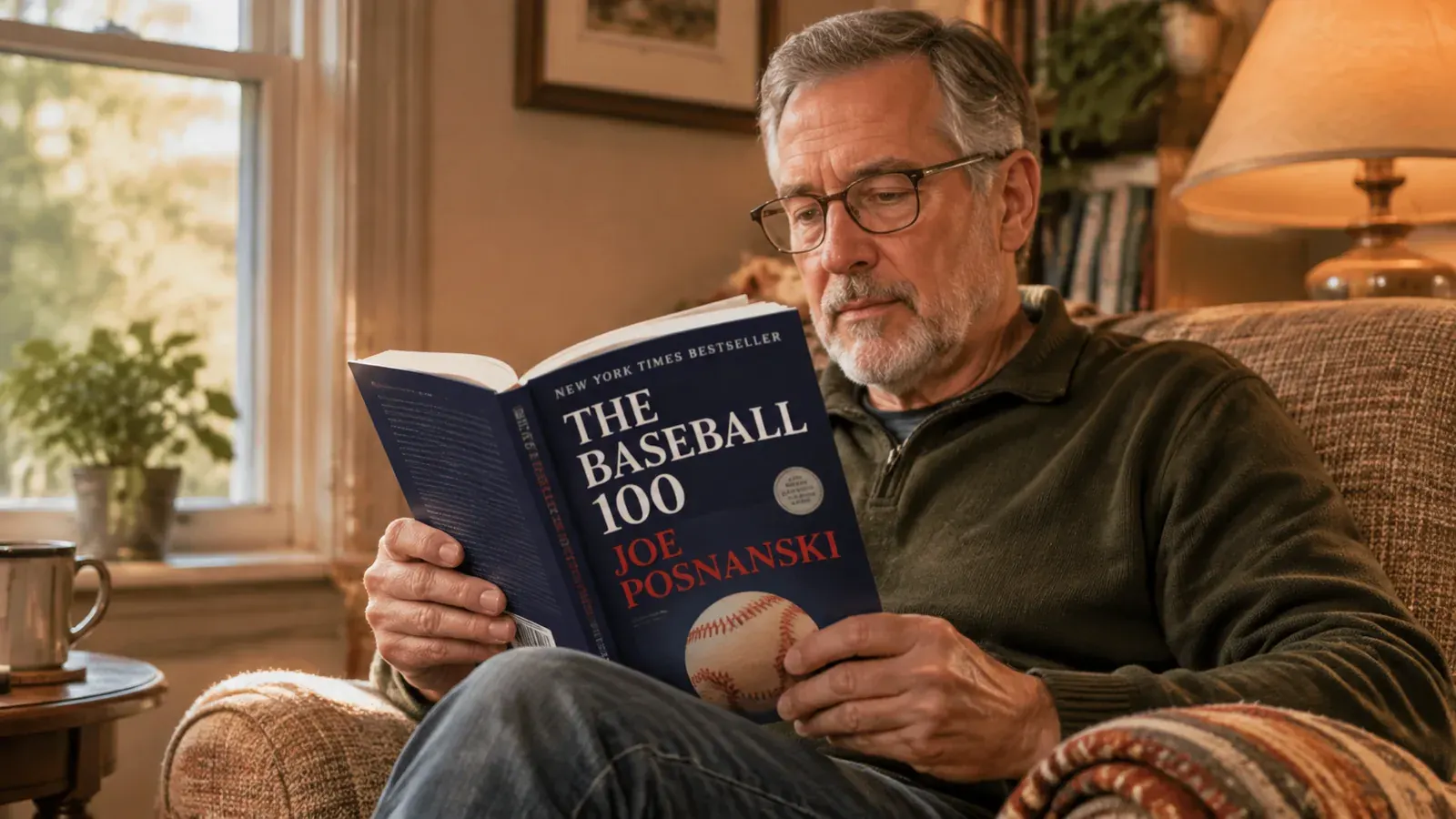
For a year I ignored The Baseball 100. My friend Tom, who has covered the game for a living since the eighties, kept pressing it into my hands, and the more he praised it, the more reasons I found to leave it closed. A ranking list, I told myself, near nine hundred pages of one man ordering the hundred greatest ballplayers who ever lived, as if a hundred years of baseball could be settled like a spelling bee. I had been burned before by that kind of book, the kind that leads with a number and then spends four hundred pages defending it. So the winter passed, and the thick hardcover by Joe Posnanski sat on my coffee table. Then, on a snowed-in Tuesday in January, out of crosswords and out of patience with the news, I opened it at page one. Babe Ruth, ranked number one. I expected the standard legend, polished smooth, in need of debunking. What I got instead kept me in my chair for an hour, and it changed the way I want to talk to you about this book.
Since that afternoon I have read it cover to cover once and dipped into it, honestly, dozens of times, and I have bought and given away three copies. Here is what none of the blurbs tell you: it is not really a ranking at all. It is a hundred short biographies held together by one argument about what makes baseball players worth remembering. Whether that is what you want is the whole question, and it is the question I am going to answer honestly, including the parts where the book falls short.
The Quick Verdict
A masterpiece of baseball writing that is also a provocation. Buy it for the hundred essays, ignore the numbers entirely, and it will reward you for years.
Amazon Check Today's Price →The honest bottom line up front, in case you only read this far
If you already love well-told baseball history, The Baseball 100 is about as safe a buy as this niche has, and it will earn today's price a hundred times over. If you are still deciding, read the sections below where I tell you where it drags, then come back and decide with your eyes open.
Amazon Check Today's Price on Amazon →How I've Used It, and What the Second Read Looked Like
I bought my first copy in the fall of 2021, not long after it came out, because I was curious and because Tom would not stop talking about it. My plan, born of self-protection, was to start with the players I knew the least, on the theory that those essays could not possibly bore me. I began with Ichiro Suzuki, the first Japanese-born position player to make it to the majors, and with the men who came out of the Negro leagues, Satchel Paige above all. Paige first pitched for Cleveland in 1948 as a rookie whose real age nobody could pin down, and the book handles that mystery the way it handles every mystery, by refusing to pretend.
That first cover-to-cover read took me most of the winter, and I want to be honest about that, because none of the praise mentions it. This is a project, not a weekend. Each essay runs only a handful of pages, so there is always a natural place to stop, but there are a hundred of them, and the book's own momentum carries you forward the way a season does. I had planned to skip around, and instead I read it straight through in order, because I did not want to miss whatever was running between the names. Somewhere past the middle of the book, I stopped checking what number each player wore and started just reading the lives.
The second read, and every read since, is a different creature. I open it to a name the way other people open a dictionary, usually because a highlight clip or a news report dragged someone out of the past. Last April it was Hank Aaron, and the essay sent me back to the night he hit number 715, April 8, 1974, the night he passed Ruth, and to the years of hate mail he carried through the chase. The book does not exaggerate that ugliness, and it does not look away from it either, and I sat in my chair for a while after. Two weeks ago it was Roberto Clemente, three thousandth hit in October, gone in a plane crash on New Year's Eve of that same year. That is what this book does. No ranking list I have ever read has done it.
One thing worth knowing about the physical object, since nobody mentions that either, is that it is dense. It will not lie open flat on its own, you will want a table or a heavy lap, and if you read in bed the way I do, you will wrestle with it a little. I keep a pencil close because I underline constantly. My copy now has more pencil in it than any book I have read since my thirties, which I have decided is a compliment to the book and a confession about me.
Where the Writing Wins
The conceit is a ranking, but the product is portraiture. Posnanski's standing as a sportswriter is not accidental, and the essay form here lets him work the way a columnist works instead of the way an encyclopedia does. He hunts for the single scene that explains a career. In the Sandy Koufax essay, he plants you in October of 1965, the first game of the World Series, with Koufax in the clubhouse in street clothes because the date fell on Yom Kippur, and he lets the silence of that decision carry the entire portrait. I had not thought about that game in years. I have not been able to stop thinking about it since.
He is just as good, maybe better, with the men whose names ring only faintly. That is the real surprise of the book, and I suspect it is the reason it endures. He treats the hundredth name on the list with the same care as Babe Ruth, which sounds like a small thing and is not. The strongest essays in the book, to my taste, are about players I had half forgotten, the ones with no legend already in place and no correct opinion to bump against. You just get a life, well told, and three pages later you find yourself a little moved and not entirely sure why.
He also refuses to grade them. There is no statistical verdict tacked onto the end of an essay, no column of numbers that settles who was better. If that is what you are buying, you are buying the wrong book, and you will know it within the first fifty pages. What you get instead is character and context, with the numbers used only when they help the story along. If you have ever put down a baseball biography because the box scores started doing the talking, this book was written for you.
And when the subject deserves a harder look, he takes it without turning the portrait into a sermon. The Ty Cobb essay is the one I hand to people who think this book is soft. Cobb was as gifted and as troubled as anyone in the game's first century, and Posnanski lays the contradiction out plainly, the genius and the meanness side by side, and then refuses to resolve it for you. He trusts you to hold both at once. That trust is the whole method of the book, and it is the reason it reads so differently from the sanitized histories I grew up on.
The ranking is the headline and the least important thing between the covers. I have read the Satchel Paige essay twice, and I still do not know how old he was, because nobody does, and that is exactly the point.
The Ranking, and the Arguments It Will Start
Now the part I want to be straight with you about, because it is the part the customer reviews rarely touch. The ranking is a gimmick, and it is a gimmick on purpose. Posnanski has said in interviews that the order is built to be argued with, that the point is the conversation rather than the verdict. Babe Ruth at number one is about the only placement that will not start a fight. Everything below that is ammunition, and the book knows it. Half the fun, and honestly a good portion of the value, is the argument it starts inside your own head when you hit a placement you disagree with and find yourself building a case for your own man. My brother-in-law and I are currently at war over the outfielders, and we are both certain the other is wrong, and the book would call that a success.
The other thing to know before you buy is that the hundred lean old. This is a book about baseball history, and most of its subjects stopped playing before 1980. There are recent faces too, players like Mike Trout and Ichiro and a handful of today's names, and they sit comfortably next to the old men. But if you are hoping for a survey of the last twenty-five years, you will be disappointed. The book is a letter to the past rather than a news report, and it is worth knowing that before you buy instead of after.

Where the Book Stumbles
If you are looking for a reason to skip it, I will give you honest ones, because a review that only cheers is doing you no favors. First, it is long. Near nine hundred pages is not an exaggeration, and while every essay is self-contained, the book's steady rhythm is real, and some readers will feel it. I know people who read it in bursts of two or three players and people who stalled out somewhere around the fifties, not from dislike but from weight. It rewards a patient reader, and that is a fact worth having before you start. If you are the kind of reader who thinks of a long book as a dent in the couch, you already know whether that is a warning or a promise.
Second, the essays are not all equal, and pretending otherwise would be dishonest. Some of them clearly came easier than others. A few of the most famous names read a little like the legend polished to a shine rather than a man pressed onto the page, and there are moments where Posnanski reaches for a closing bow and the paragraph ties itself up a little too neatly. I noticed it more on the second read than on the first. It is the price of a warm style, and it never once stopped me from turning the page, but it is there.
Third, and this is the thing the five-star reviews never tell you, it is not a history for beginners. Posnanski writes as if you already love the game, which you will find either delightful or maddening. He will mention a doubleheader in 1967 without pausing to explain why doubleheaders mattered, because he trusts you to know. He is also warm to almost everyone he writes about, and if you want a critical history, one that grinds an axe about the business of the game or the pace of its integration, you will not find that axe here. This is a book of affection, not grievance.
Finally, a smaller thing that matters more than it should: the book assumes you already have your affection banked. It never builds a case for why baseball is worth caring about, because it does not think it has to. I read it the winter after a long season of strikes and channel blackouts and general sour feelings about the sport, and there were stretches where it felt like a letter from a happier era than the one I was living in. That is not exactly a flaw. It is a reminder that this is a book for fans, the warmest kind, not for people who still need convincing.
What I Liked
- A hundred self-contained essays, short enough to finish one before bed, easy to enter at any point
- Prose at the level of the best sports writing; he finds the fresh scene even in the most written-about lives
- No verdicts and no stat tables, just men rendered well
- A genuine gift book, the kind you buy, lend, and press on people after a good conversation
- Sends you back out to watch old highlights, reread other books, and argue with your own opinions
Where It Falls Short
- Near nine hundred pages; a cover-to-cover read is a winter's project, not a weekend's
- The ranking invites arguments and settles none of them
- Mostly a book about baseball before 1980; the modern game gets a thin slice
- Not a beginner's introduction; it assumes you already know the game
- A few essays lean on familiar lore and tie their bows a little too neatly
Who This Is For
I have bought and given away three copies, and I think that is the most honest evidence I can offer about who this book is for. It is for the reader who follows baseball, yes, but more precisely for the fan who already owns a biography or two and wants the whole century in one place. It is for the fan who argues about the greats, because it arms you with a story instead of a statistic. And it is for the gift that is supposed to mean something. I gave a copy to my brother-in-law, who played college ball and has not finished a book in years, and he called me three weeks later to argue with me about a player I had to look up. He has since bought two more copies for people at his office, which is the only review that has ever mattered to me. It is also, and this matters if you are the household's gift-giver, a book you will probably end up buying twice, once for yourself and once for the person you realize needs it.
Who Should Skip It
Skip it if what you want is a decision. If you are buying a book that will settle, once and for all, who the greatest player was, this one will frustrate you, because it refuses to be a verdict and its own ordering is built to be doubted. Skip it if you want the modern game, because you will get a small handful of recent faces and a great deal of the past. Skip it if you are new to baseball history and want a straight chronological story, because this is a mosaic rather than a timeline, and its best essays assume you already love the game. And if you read sports history the way you read a dictionary, in search of entries, you will find your answer faster in a reference book, because this one insists on telling you a story.
If you read nothing else this winter, read the first thirty pages, then decide
The Baseball 100 is the rare book I can recommend honestly, with its weight and its flaws on the table. It will sit on your shelf for a decade, it makes a gift that keeps producing conversations, and with the paperback it stays easy to give. Check today's price on Amazon, order a copy, and open it to the player you are most curious about. I already know it will not be the page you planned to stop on.
Amazon Check Today's Price on Amazon →