

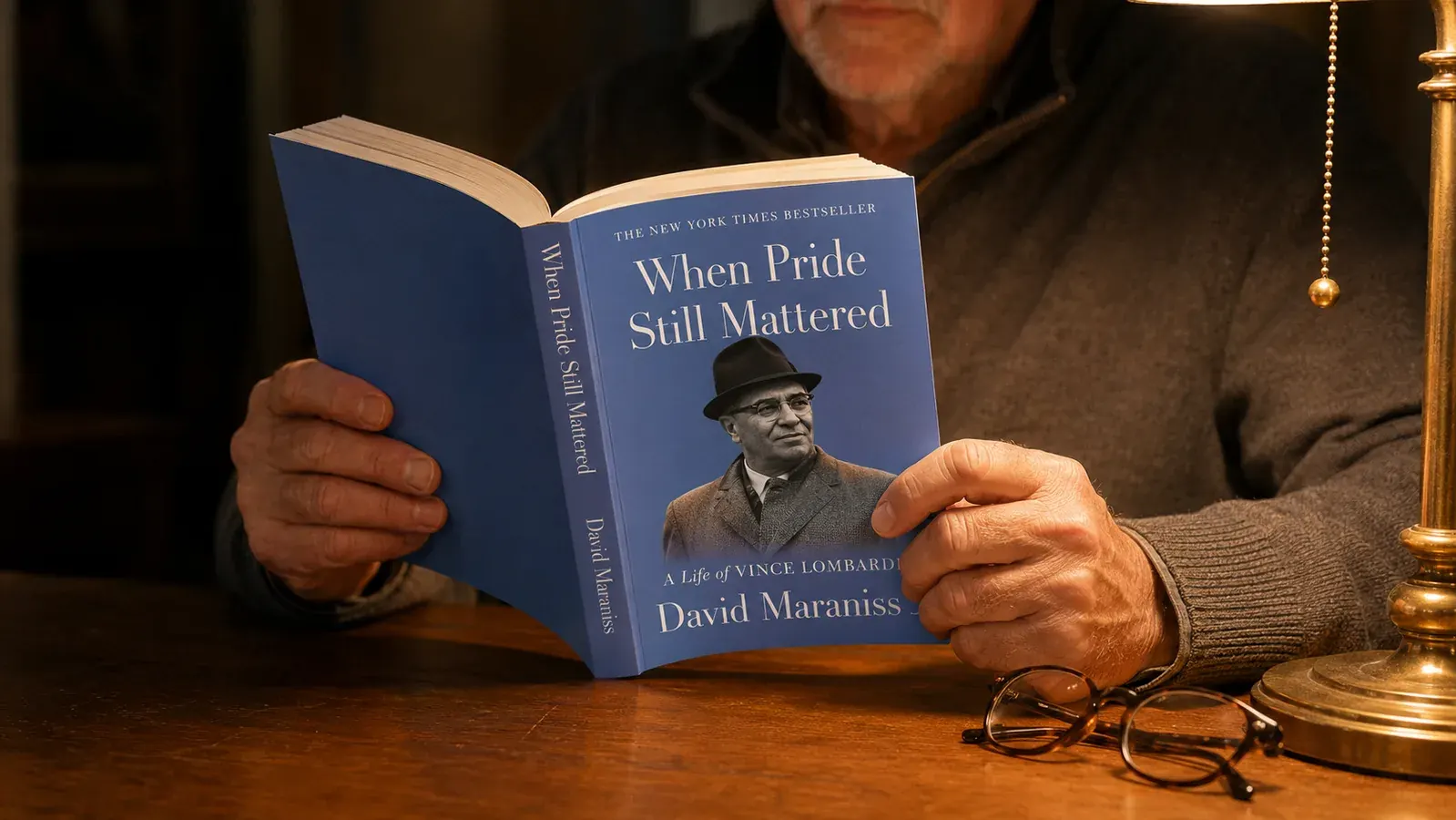
Here is the thing nobody says out loud before you buy David Maraniss's biography of Vince Lombardi, the biggest one there is: it is not a page turner, and it knows it. I do not say that as a dismissal, because it is the very reason the book matters. I am Gordon Ellis, I read history books most nights for the pleasure of it, and When Pride Still Mattered still took me six full weeks of patient evenings. I started it in late September, sure I would rip through the arc from Brooklyn to Super Bowl I in a single long weekend. By November I was still inside the Green Bay years, checking how many pages remained the way you check a fuel gauge on a long drive. That is the honest warning I wish someone had handed me with the book.
The book has earned its standing. David Maraniss won a Pulitzer before he wrote it, and nearly every serious top football history list puts it near the top because it belongs there. What I want to add is the half of the story the five-star reviews skip. This is a heavy, serious, deliberately slow piece of history. It treats one stern man's life as the story of post-war America, and it asks you to sit down and stay with it. If you want a breezy feel-good read about Lombardi's greatest moments, this is the wrong book entirely. If you want the actual man behind the legend, this is the only football book that truly has him.
This is the honest review I wish I had found before I weighed the purchase, so I am writing it for whoever is standing where I stood. It is not going to be a rush of undiluted praise, because the book is better than that. It is going to tell you what is genuinely great, what will genuinely test you, and who should pick it up with full confidence and who should walk past it without guilt. That is the whole of what follows.
The Quick Verdict
Definitive, and it deserves the title, but it meets you halfway. Come expecting the real Lombardi and the culture around him, not a highlight reel, and bring real patience.
Amazon Check Today's Price →If you want the real Lombardi, not the legend, this is the one book that delivers him
Every serious football history shelf needs this on it. It is the biography every other Lombardi book is measured against, and honestly there is no second place worth arguing about.
Amazon Check Today's Price on Amazon →How I've Used It
I read the hardcover over those six weeks, a chapter or two each night after the house went quiet, always with a pencil. The margins are full now. Before this one I had read the shorter Lombardi books, the ones that turn every story into a lesson about effort, and I came to Maraniss's version wanting to understand one thing: why the Green Bay Packers of the sixties mattered so much more than a winning streak.
The honest answer, once Maraniss is done, is that Lombardi arrived at the exact moment the country seemed to need a lesson in work and discipline, and he embodied it without ever quite fitting it. The book gave me that understanding, and on top of it a thing nobody warned me about. There are stretches in the middle, especially before he reaches Green Bay, where it feels like very little happens the way a sports story is supposed to happen. It is a slow portrait of a young man turning stubborn and opinionated. I set the book down twice wondering if I would come back to it. I am glad I did.
I also bought a second copy as a gift for my brother, who coached high school football for thirty years and never got around to the big Lombardi books. He finished it in three weeks and called me with a long silence before saying it made him rethink his own sideline. That is the effect this book has when it reaches the right reader. It does not entertain you. It reorders how you see something you thought you understood.
What This Book Actually Is (Not What You Assume)
Calling it a football biography undersells it, and that is the first honest thing to understand about it. Maraniss uses Lombardi's life as a map of mid-century America. The opening chapters walk through his childhood in Brooklyn, the Fordham years where he played offensive line in the group known as the Seven Blocks of Granite, the long hungry years of coaching and army service, and the slow climb up through West Point as an assistant before Green Bay ever heard his voice roar.
All of that means the book voluntarily spends whole chapters on immigration, on the discipline of Catholic schools, on the Depression and the military culture Lombardi absorbed as a young man. A reader who came for touchdowns will hit stretches that read more like social history than a football book. It is all relevant, and Maraniss earns every page of it, but the honest warning stands: the football does not take center stage until the story reaches Green Bay, and even then it shares the spotlight with everything else that was happening to the country in those years.
There is a chapter early on where Maraniss recounts Lombardi's own memories of his father and of the immigrant neighborhood that raised him, and it is the best kind of slow. Nothing is rushing to happen. You are simply standing in a place where a certain kind of American character was built, and when the book finally lets him walk into a locker room you understand what he is carrying in with him. No highlight reel could do that. Only a patient biography can.
I think that framing is exactly why the book outlives the other Lombardi biographies. A hundred books tell you what Lombardi did on the sideline. This one tells you why a nation was ready to hear it, which makes the coaching chapters feel like the payoff of a much longer argument rather than a string of famous anecdotes. You do not read it. You earn it, and then you understand it.
Where It Shines: The Man Behind the Sermon
The reason this book sits above every other Lombardi biography is that Maraniss refuses to flatten him into a mascot for discipline. He could be genuinely hard on people. Players on the roster who could not keep up were cut without sentiment, and the screaming was real, the face-to-face fury that men described for the rest of their lives. Maraniss does not polish that into a tidy motivational story. He lets the harshness sit right next to the tenderness, the angry father figure who also wept with his players and quietly passed money to men who had nothing.
That honesty is the whole difference. Lombardi could cut a man on Monday and carry his kid on Tuesday, and Maraniss will not tell you which one to admire. He trusts the reader to hold both truths at once. Few sports books have the nerve to do that, and it is why this one is the standard that every other book in the genre is measured against. It explains how the man produced greatness and resentment from the same gesture, which is the thing the legend never shows you.
There is also the quality of the prose itself. When Maraniss is at his best, and he is often at his best, the sentences have a plain weight to them that suits the subject. He does not need fireworks because the truth is dramatic enough. The chapter on the Ice Bowl, for example, is the single best account of a football game I have ever read, and it reaches that level by being calm and exact rather than loud.
How It Sits Against the Shorter Lombardi Books
Before this one I had always reached for the slim volumes, the ones built around his famous quotes and the mythology of the sideline. They are a pleasure to read, and I know plenty of men who keep one within arm's reach for a quick jolt of motivation. Almost none of them tell you the Packers nearly lost him, or that his harshest moments made some players walk away from the game entirely, or that his last years in Washington were mostly tired ones. Maraniss tells all of it, and it made me read the slim books differently, as the legend that had to exist so the man could have a story at all.
That is the real value of the honest biography. It does not cancel the legend, it gives it a foundation. The yelling still happened, the discipline still worked, the three championships still came. But now I understand the effort behind each of those things, and the cost, and I would rather have the real picture on my shelf. That is the trade this book offers, and it is the reason I reach for it over the ones that flatter.
What I Liked
- The definitive biography; Maraniss interviewed nearly everyone still alive from Lombardi's life and it shows on every page
- Shows Lombardi whole, the harshness and the tenderness together, instead of flattening him into a lesson
- The Green Bay dynasty chapters are some of the best sports history ever written, especially the Ice Bowl account
- A serious portrait of American culture in the 1950s and 60s hidden inside a football story
Where It Falls Short
- Long and slow to get going; the pre-Green Bay years will test a reader who only wants the legend
- Emotionally cool, not a celebration, so it will not fire you up the way shorter Lombardi books do
- A heavy physical book that is hard to hold in bed for long stretches
- Assumes real patience and attention, so it is the wrong pick for a quick sports read on a trip
He could cut a man on Monday and carry his kid on Tuesday, and Maraniss will not tell you which one to admire.

The Honest Caveat: It Is Heavy, and It Knows It
Here is the part the praise always leaves out. The prose is unhurried the way a serious novel is unhurried. Maraniss writes long sentences and longer scenes, and he trusts you to stay with a full chapter on a single afternoon of a 1967 game without hurrying anywhere. To a reader who loves deep, patient narrative history, that is a gift. To a reader who hoped to collect the Lombardi story in a fast weekend, the book will wear you down before it wins you over.
And there is the physical weight of the thing. The hardcover runs past five hundred pages and sits in a lap like a heavy newspaper. It is not a read it on the bus book, it is a table and a lamp and a quiet hour book. That is not a fault on its own, it is just the truth, but it is the real reason so many copies are bought with the best intentions and left a third of the way in. Nobody warns you about that, so I am going to be the one who does.
The other caveat is emotional. Every short Lombardi book makes you want to run through a wall. This one does not, because it refuses to pretend the wall is the point. It is a cooler, more honest telling, and for a reader who wanted to feel the old charge of it, the flatness can read as distance. Keep that expectation and the book rewards you. Carry it and you will feel let down by a masterpiece that was never trying to cheer you up.
Who This Is For
This is for a reader who wants the man, not the myth, and who will stay for a long, serious telling. It is for the fan who loves football history enough to want the decades of context around it, the reader who has finished the shorter Lombardi books and suspects they were missing something. On my shelf it is the book I hand to someone who already understands the game and needs to understand where the game's assumptions came from.
If that is you, buy it and clear some evenings. Read it the way it wants to be read, slowly and with a bookmark nearby and no plan to finish it fast. It repays that patience more than any other football book I own, and I own a lot of them.
A good test is whether you have already bought the man or the myth. If your current Lombardi shelf is the books with his quotes on the cover and an arrow pointing at a leadership lesson, this one will feel at first like black coffee after a lifetime of sweetened milk. Give it a chapter. By the time he reaches Green Bay, nothing else tastes quite as real.
Who Should Skip It
If you want a brisk, uplifting sports story to finish on a flight, this is not it, and there is no shame in that. If several hundred pages of mid-century cultural history sound like homework, grab one of the dozens of shorter Lombardi picture books instead and keep your evenings light. This is a masterpiece, but it is a masterpiece for a specific reader, and telling everyone they must love it sells both the reader and the book short.
Know yourself before you add it to the cart. If you finished the last serious history book you started, this will be one of the best things you have ever read. If you usually read books with the remote nearby, choose something else. There is no middle ground with this one, and that honesty is the whole point of a real review.
One more honest note. If you coach, or you manage people, this book will not leave you alone. It will sit with you at your desk, because it does not pretend Lombardi's methods were simply right or simply wrong. If you would rather not spend your evenings being quietly confronted about how you lead, this might be more than you signed up for. Pick it up when you are ready to be examined instead of entertained.
The definitive Lombardi book is waiting for the right reader
It is patient, heavy, and unhurried, and for the reader it is written for, it is the best football history ever published. Check the current price and decide if that reader is you.
Amazon Check Today's Price on Amazon →