

I read history the way other men watch Sunday football, a few chapters most evenings in a chair by the lamp. And for a long time I bounced off boxing history completely. The books were full of dates and rounds and purse figures, who stopped whom in the seventh in 1951, and it felt like reading a ledger instead of a story. I wanted the drama I remembered from grainy replays, the tension of a big fight, the men behind the gloves. What I kept finding was a scorecard with a hardcover on it.
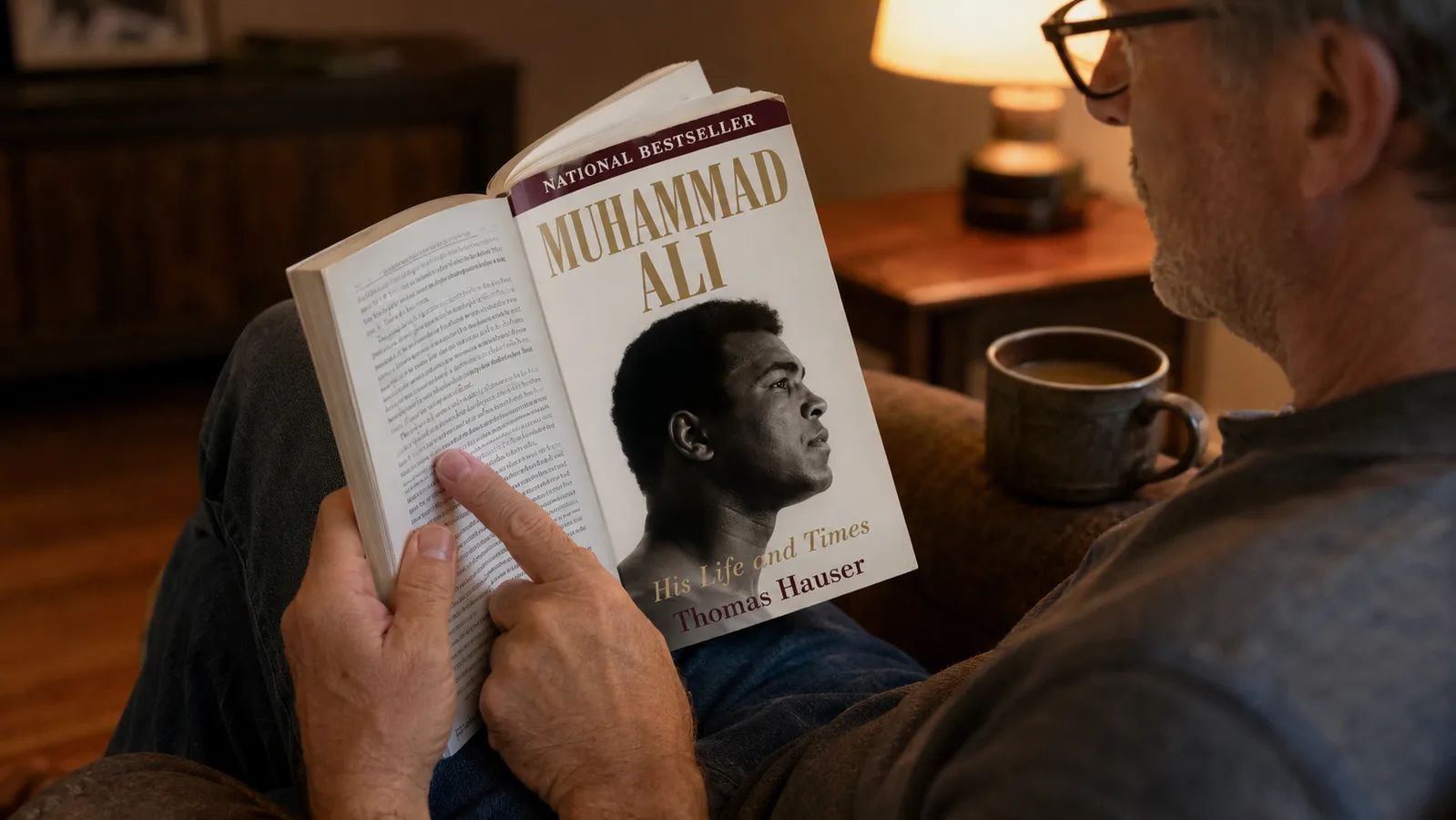
The book that fixed the whole thing for me was Thomas Hauser's Muhammad Ali: His Life and Times, and it fixed it by not behaving like a boxing history at all. It reads like a novel, a long one, carried by hundreds of voices instead of a single narrator. Once I saw how Hauser did it, I could read almost any boxing history with enjoyment, because I finally knew what to look for. This guide is the five steps I now use every time I pick up a book about the fight game, whether it is about Ali, Joe Louis, or a fighter I have never heard of.
The book that taught me how to read boxing history
Thomas Hauser's Muhammad Ali: His Life and Times is the biography I measure every other boxing book against. It lets Ali and the people who knew him tell the story in their own words, and it is the model for everything in this guide.
Amazon Check Today's Price on Amazon →Step 1: Start With One Fighter You Care About
Boxing history is a hundred years of fists and faces, and trying to take it all in at once is how you end up with that ledger feeling. The cure is to walk in through a single door. Pick one fighter, not a division and not an era, and read about that man until you care what happens to him. Ali is the obvious door for most readers, because nearly everyone watching the ice bath news clip in 1996 felt something, and because his life touches the civil rights story, the draft, Vietnam, and the changing country in a way no other fighter's does. But the rule works with anyone. Joe Louis in the Depression, Sugar Ray Robinson at his peak, a journeyman from your own hometown.
Once you care about the person, the fights stop being statistics and start being chapters. You will want to know whether the old man with the slurred voice survives the next round, and that is the entire engine of narrative. Hauser understood this completely. He spends pages on Ali's childhood in Louisville, his first amateur fights, the stolen Schwinn that started everything, before the heavyweight title ever appears. By the time Liston is in the ring opposite him, you are not watching a bout report. You are a few chapters deep in a life you have invested in.
The practical version of this step is simple. If a boxing history book opens with a table of contents full of years and venue names, stop and find the one that opens with a character. A great boxing book introduces the fighter as a person before it introduces him as a champion. Start there, and the history follows almost without effort.
Step 2: Read for the Voices, Not the Verdicts
Boxing is a sport where the people around the fighter matter as much as the fighter does, the trainer, the cut man, the promoter, the reporter who covered him. And the books that read like stories are the ones that hand the microphone around. Hauser did this at a scale nobody had tried before. He interviewed Ali himself over two years, then talked to his mother, his wives, his trainers, the men who fought him, the doctors who cared for him, lawyers, journalists, fans who had met him once. He stitched those interviews into one continuous account, a kind of chorus where the narrator barely appears.
That is why the book feels so alive, and it is the thing I look for now in every boxing history I open. When a chapter is built from eyewitnesses instead of a single author's paraphrase, you get the texture that a record book can never carry. Someone remembers how Sonny Liston's eyes looked across the ring. Someone else remembers the smell of the dressing room in Manila. Those details are the difference between knowing a fight happened and feeling like you were present at it. Even a shorter biography can borrow the trick: just writing "his trainer said" once in a while does more than a hundred punch counts.
There is a discipline to this that is worth honoring too. A book built on many voices is also harder to fake, because the people contradict each other, and a good writer leaves the contradictions in. In Hauser's book, you hear favorable versions of a story and then the other side, and you get to decide what actually happened. That honesty is rare, and it is exactly what makes a boxing history feel trustworthy enough to settle into.
Step 3: Put Every Fight Back in Its Year
The way most of us learn boxing history, the fights hang in a void. Ali beat Liston in 1964, beat Foreman in 1974, lost to Spinks in 1978, and that is the whole arc. But those dates are the least interesting part of the story, because the fights do not sit in a void at all. They sit in a specific America. The refusal to be drafted in 1967 is not a footnote to Ali's boxing career. It is the center of his life for three and a half years, a decision that cost him the title, and the moment the country had to take a side.
Reading boxing history with a calendar open changes everything. The Rumble in the Jungle in 1974 makes sense only when you remember Nixon had resigned that summer and America was in a rotten, cynical mood, hungry for something clean and brave. The Thrilla in Manila in 1975 happens against the fall of Saigon, and two exhausted men fighting past the point of sense starts to read like a story about the country itself. This is the deep pleasure the genre offers: boxing history is American history with a pulse.
So before you read a big fight, spend one minute anchoring it. Which year was it? What was happening in the country? What was happening to the fighter outside the ring? Hauser gives you every piece of that context in sequence, which is why his book works, but you can bring the habit to any boxing history you read. It turns a round-by-round account into a story about a man at a particular moment in time, and once you see the fights that way, you will never read them as a scorecard again.
Once I learned to read a fight as a moment in a life instead of a line in a ledger, boxing history became the American story with the most pulse in it.

Step 4: Follow the People Around the Fighter
Somewhere in the first third of Hauser's Ali biography, you realize the supporting cast is the whole point. Angelo Dundee leaning on the corner between rounds, telling calm things to a man whose face is swelling. Bundini Brown, the cornerman and poet who coined the phrase that followed Ali everywhere. Howard Cosell, who argued for Ali on national television when nearly everyone else had walked away. Joe Frazier, the man Ali tormented publicly for years and who fought him three times with more heart than anyone had a right to. Those people carry as much of the story as Ali does.
Most casual readers skip the supporting cast because the names are unfamiliar, and that is a mistake. Follow them. When a trainer or a rival appears in the second chapter, remember the name, because by the eighth chapter that same person will be the one holding the story together. Boxing history is a web of long relationships, grudges that run decades, friendships that survive worse. The fighters themselves will tell you the rivals made them. Reading for the second string is how you feel the weight of the relationships, and it is also how you keep straight who is who when the book jumps around in time.
Hauser's biggest gift to the reader is that he lets those people tell their own versions of Ali. Frazier talks about what the insults cost him, and you come away sorry for a man who won one of the greatest fights ever fought and is remembered as the loser. That is the kind of richness a single narrator just does not reach. If you want to read boxing history for the story, read it for the ensemble, because the ensemble is where the story actually lives.
Step 5: Let The Book Hand You the Next Book
A good boxing history is not a dead end. It is a doorway with other doorways inside it. Hauser's biography is generous about this. By the last chapter you have heard enough about Frazier, about George Foreman, about the young Sugar Ray Leonard, about the whole sport in the seventies, to know exactly what you want to read next. Follow those hooks. If your boxing book mentions a rival who fascinates you, go find that fighter's biography. If it quotes a journalist you enjoyed, go find that writer's own book.
This is how a casual interest becomes a shelf, and it is the natural way to read history. You do not read a syllabus. You read one book, it points you at another, and suddenly you have a working picture of the whole sport built out of stories you actually remember. The Ali biography is a strong start because it connects to almost everything, the heavyweight era, the civil rights years, the media circus of the twentieth century. Read it and you will never be short of a next book. Pick up the other Ali titles on this site, the honest review and the comparison with his own memoir, and see where the thread takes you.
What Else Helps
A couple of habits stretch a boxing history book further. Watch the fight after you read about it, not before. If you know the outcome already the reading loses its tension, but if you read the build-up first and then see the footage, both feel richer. Tape a note to the inside cover with the fighters' names and the year, the way you would Park a story you want to remember. And for readers in the family who grew up with these fighters, a boxing history book is the rare gift that starts a conversation, so buy one you can talk about over the table rather than a dry reference they will shelve politely.
One honest caution. Hauser's book is long, and the middle stretches do slow down while the years of exile from the ring get told in detail. That is part of the story, but it means this is a book for a reader who has a little patience, not the perfect first boxing book for someone who wants a single night's fight. For that reader, start with the shorter books and let the Ali biography be the reward after a few wins.
Start with the biography that reads like a novel
If you want to feel boxing history as a story instead of a scorecard, Thomas Hauser's Muhammad Ali: His Life and Times is the book I would put in your hands first. Check today's price before you order.
Amazon Check Today's Price on Amazon →